
Dominican Higüero Gourds
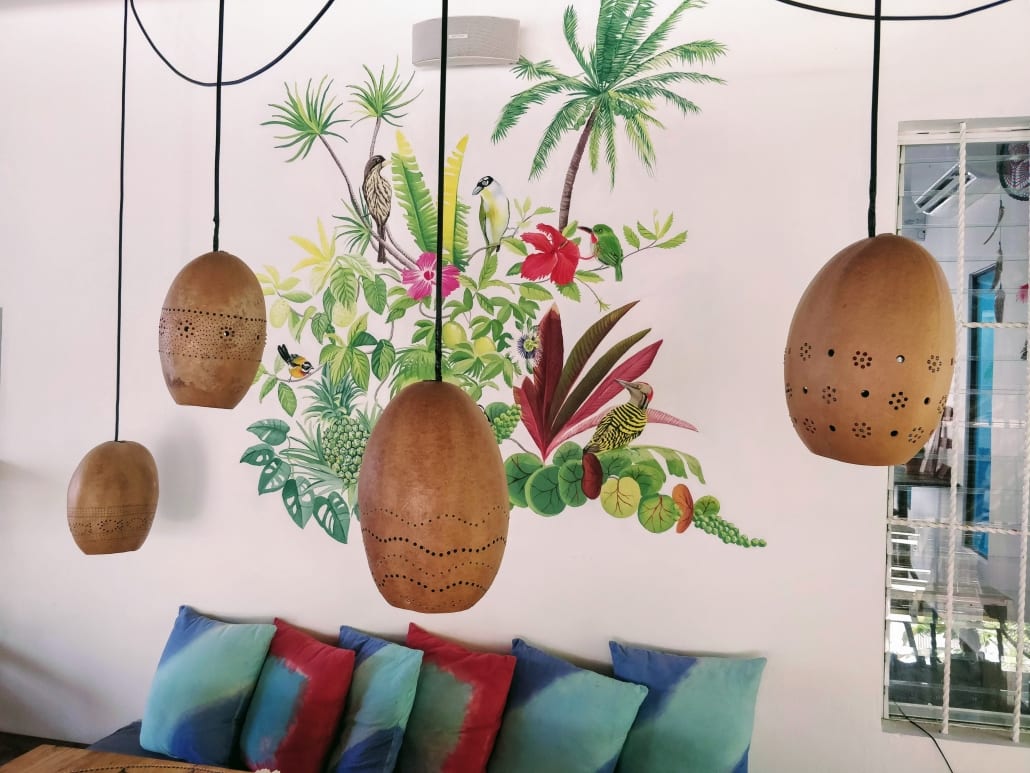
The first higüero gourd I saw was a lampshade in a restaurant. I assumed it was made of dried-out coconut shell, as it was rounded and had that lovely brown colour. But, when I asked the waiter, I found out it was actually a seed from the higüero tree. It was beautiful. The artist had pierced it with little holes so that it projected pretty patterns onto the walls, when the light shone through it. I was fascinated. I learned that the hard shell comes from a fruit which dries and hardens in the sun to form a wood-like material. You can scoop out the white flesh and carve patterns into the skin that dry on. Kind of like an inedible pumpkin. The fruit take a really long time to ripen, up to seven months of hanging on the tree. While the higüero tree is found in other tropical countries, the gourds elsewhere tend to be more rounded, like a grapefruit. The Dominican higüero variety produces an elliptical capsule about the same size and shape as a watermelon. Fibre from the tree can be twisted into ropes, and the wood makes strong tools. All, in all, it’s a very useful tree. The two dots above the ‘u’ indicate that higüero is pronounced ee-gweh-roh. In ‘gue’ syllables in Spanish, the ‘u’ is normally silent (pronounced geh), unless it carries an umlot which means the ‘u’ can join in the fun. There you go. But back to the higüero at hand. Nowadays, the higüero fruit is mostly used to make decorative objects and ornaments. But, historically, it was used in all sorts of ways. The skin is strong, durable and holds water, making it ideal for kitchenware. Folk made big serving bowls (fruit cut in half lengthways), little eating bowls (fruit cut in half widthways), sieves, ladles, spoons, cups, vases, and much more. Higüero pods that had been hollowed out through a small hole at the top were used to carry water. How’s that for an all-natural water canteen? With a bamboo straw, you’d be set. But that’s not all. The Taino people native to the island used the higüero gourds to make music. They filled small hollow gourds with little pebbles or hard peas to shake: maracas. They carved grooves into the shell on one side of the fruit and a hole on the other to make a scraping board: a güiro. The Taino may have used the higüero to make hunting masks. The idea was that birds and animals were not frightened of the dried husks, so hunters cut out eyeholes and wore them over their faces as masks. This would work especially well in water, where the hunter could wade in and be dismissed as a floating fruit by the prey. S-M-A-R-T. Artisanal higüero products can make for a great souvenir from your vacation to Cabarete. Keep an eye out for sellers and stores around town, there are many that sell the handmade ornaments. If you want a real traditional Dominican experience, you could even have a go at carving your own higüero decoration! Go out there and make some memories! Just don’t cut yourself.
Cabarete Spotlight: Kiters 4 Communities

Kiters 4 Communities is a local social business in Cabarete that upcycles unusable kites into cute beach bags. The profits from the bag sales fund projects in the local community to improve prospects for Haitian immigrants. Many Haitians come to seek a better life in the Dominican Republic. Communities on the westerly side of the island struggled to recover after the 2010 earthquake, and Haiti lacks the infrastructure that can be found in the DR. The Haitian immigrants, however, often find it very difficult to find employment when they get here, as they lack the training and schooling. Here’s Maxom preparing the kite material for the tailor. Local initiatives like K4C take the extra time and effort to equip their team with the education they need to thrive in their position. A little basic training transforms the prospects of individuals, and gives them confidence in their abilities. Team members collect discarded and donated kites, inspect the material and prepare it for the tailor. They are in charge of the day-to-day running of the business, and liaising with retailers who want to buy the bags to sell. Kiters 4 Communities: The Beginning Pioneer kiter Laurel Eastman came up with the idea for K4C in 2004. At that time, kiteboarding was really taking off as a sport, but the kiter community was leaving a lot of waste in Cabarete. Laurel started repurposing out-of-use or broken kites into bags, and K4C was born. Laurel was one of the first professional female kiters around. She has poured her energies into the sport and into improving the lives of others through humanitarian projects in the DR. Laurel teamed up with Pete Richardson and Soniel, K4C’s genius Haitian tailor, to take her idea to the next level. K4C Impact K4C currently supports two schools for Haitian children and a program for providing balanced meals. In the past, they have funded all sorts of projects to invest in the local community. These include providing free English lessons for local women and building a whole new building as a multi-use community space with the Haitian immigrants. Their business model really is a win-win-win. The profits improve the prospects of Haitian immigrants. K4C employs and trains locals to run the business, putting money in the local economy and empowering their team. Sturdy kite materials are kept out of landfill and repurposed. And you get a gorgeous and durable beach bag. Add another win to the list! Get involved You can buy their bags in stores around town, including in the LEK kite school. Alternatively, you can donate through their website and support the amazing work K4C do here in Cabarete and the surrounding area. The owners take care of all the costs of running the business, so you know every cent you give will go directly to the local communities in need. Join us next time as we spotlight another organisation that is brightening Cabarete’s future!
Larimar: The Dominican Gem
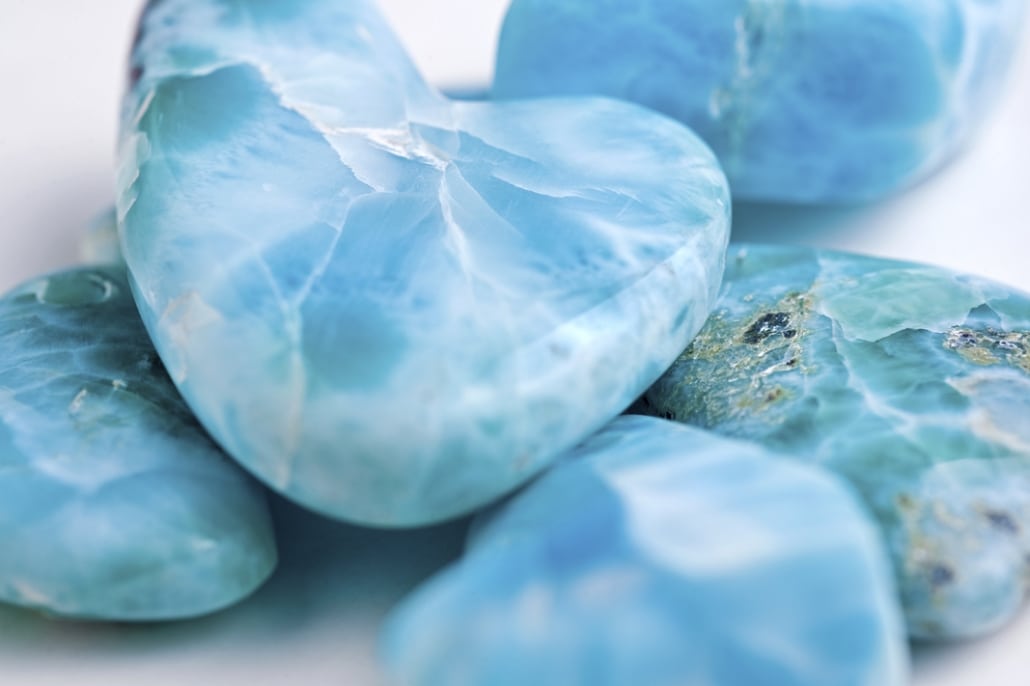
Larimar is a beautiful sky-blue gemstone that is exclusively found in the Dominican Republic. It makes for a gorgeous gift to take back to loved ones at home, or keep it for yourself as a unique souvenir of your Dominican adventure. Larimar, also known as ‘Stefilia’s stone’, is a blue gemstone variety of pectolite, a silicate mineral. Pectolite means ‘compacted stone’ in Greek and is usually a white-gray colour. It is the copper atoms in the crystalline structure that give larimar its recognisable blue colour. While most commonly found in this soft, sky-blue colour, larimar can also be pale white-blue, green-blue and even deep blue. The stone can also contain colour variations like red spots or brown streaks, due to oxidation or the presence of other minerals. The bright blue colour can fade over time, so store your treasure safely out of direct sunlight. When was larimar first discovered? It’s uncertain exactly when larimar was discovered on the island. National mining records show a request to explore a mine of blue rock in 1916, but permission was denied. Natives are said to have referred to it as ‘blue rock’. Decades later, in 1974, Miguel Mendez and Peace Corps volunteer Norman Rilling found the blue rock again, on the coast of Barahona. They named it larimar by combining the name of Miguel’s daughter Larissa with the Spanish for sea, ‘mar’. The Los Chupaderos mine was set up soon after, on the southwesterly side of the island. The mountainside is now covered with about 2,000 vertical mining shafts; the surface littered with the blue rock deposits. An Energetic Gemstone Crystal spiritualists say that larimar holds tranquil sea and sky energy. It is believed to have balancing powers because of its connection to the elements of water, earth and fire. Larimar was forged by volcanic activity but its colour dances with the ease of the Caribbean sea. Apparently, this gives it the power to calm fiery tempers and soothe a worrying mind. Many Dominicans use it as a lucky charm, and find comfort in its harmonious, feminine energy. It is also associated with the dolphin, and the animal’s playful wisdom. The gem is usually set in silver, though high quality larimar is sometimes set in gold. If you’re interested in learning more about the Dominican local gemstone, you could pay a visit to the Larimar Museum in Santo Domingo. In Cabarete, you can pop into a larimar jewellery store and see many varieties of the gem. The staff at Yocahu in Cabarete town centre will be happy to talk to you about the stone. Who knows, maybe the soothing larimar will inspire some peaceful rest in your active Caribbean vacation!
Protect the beautiful Parrotfish!

Cabarete is blessed to be by the ocean. Located on the North Coast of the Dominican Republic, Cabarete boasts beautiful beaches, a protective coral reef, and fresh fish dinners. All this amazing nature relies on a delicate balance of wildlife that inhabits the waters. The parrotfish plays a key role in maintaining the health of the coral reef and our lush beaches. Unfortunately, the colourful parrotfish is currently an endangered species, mainly due to overfishing and being eaten by lionfish, pest of the sea. In the Caribbean, it’s common to see parrotfish or loro pop up on your dinner plate. Especially, in small beachside or roadside eateries. Indeed, many local fishermen don’t know how important the fish are, and lack awareness of sustainable fishing practices. Let’s learn some more about this remarkable fish. Sex changes and homemade pyjamas The parrotfish is quite the fluid creature. It baffles scientists with its ability to change sex multiple times over its lifetime. They hang around in schools, or harems with a dominant male. When this ‘supermale’ dies, one of the females will switch to male and assume his role! Parrotfish colouring is spectacular. Their bright colours vary dramatically within the same species, and there is a lot of overlap across species, making them a challenge to classify. They also wear pyjamas. Well, kind of. Parrotfish secrete a sort of mucus sack every night before they go to sleep. It forms a transparent cocoon around them, and we think it might help mask their smell from the prying noses of predators. Parrotfish teeth are really, really hard. They are made of fluorapatite, one of the hardest biominerals in the world. Parrotfish teeth are harder than metals like copper and silver, that’s how they can much on the reef so well! As well as generally being a cool and awesome fish, parrotfish also do some super important work for the environment. Coral and beach superheroes Parrotfish live off a diet of algae that is found in the coral reef. They have special teeth in their throat that grind up the hard coral into little bits. These bits are important to us because they make their way out of the parrotfish and onto our beaches as sand. Yes, white sand is largely fish poop. Wiggle your toes in that. Estimates vary, but parrotfish may be able to produce up to 380kg (840lbs) of sand every year. That’s a lot of beach! Beach erosion is a serious concern, and overfishing parrotfish will only put our coastlines in greater peril. Caribbean economies rely heavily on tourists flocking to their beautiful white-sand (parrotfish poop) beaches. Further loss of beach sand could be disastrous for their livelihood. Marine conservation organisations are working to protect parrotfish, as they reckon the fish are super important to the health and longevity of the coral reef. In the Caribbean, parrotfish eat sponges and algae, which helps maintain the coral reef and prevent it from being overgrown. Sort of like Nature’s underwater lawnmowers. In other words: Save the parrotfish, save the reef. Did you know? Raw parrotfish is a Polynesian delicacy, and was once considered so special it was only eaten by royals. Parrotfish get their name from their fused mouth structures that look like parrot beaks. And their pretty colours. Over to you! As a tourist on vacation in the Caribbean, you can help protect our reef and beaches by not supporting the parrotfish fishing cycle. Take care to ask in a restaurant which fish is being served, and don’t eat parrotfish (loro)! Our resident nutritionist recommends the Seafood Watch app by Monterey Bay Aquarium. It has excellent searchable information to help you make sustainable, ocean-friendly choices. A handy tool, indeed.
Lake Enriquillo

Lake Enriquillo is a Dominican hidden gem. It’s not as well known a feature as the pristine white sand beaches of Bayahibe or the impressive colonial monuments of the capital city. But, this lake is something quite special. What’s so special about Lake Enriquillo? Lake Enriquillo is pretty superlative: at over 350 sq km (135 sq miles), it’s the largest lake in the Caribbean, and it’s the lowest point of the Caribbean at 43m (140ft) below sea level. It has the largest American crocodile population of any region in the Caribbean, and is home to plants and wildlife that endure in arid conditions, like cacti. The Lake has no outlets, so has become a natural saltwater lake. Its salinity varies between being comparable to the saltiness of seawater and being up to three times saltier. This is called hypersalinity, and makes for a harsh ecological environment. Life nevertheless thrives in this place of breathtaking natural beauty. The lake is surrounded by a beautiful tropical and dry forests, natural springs, and fruit plantations where coconut, banana and mango are grown. Visitors can enjoy the lake by car, driving the 60km road around the perimeter, or by taking a boat trip on the lakewater. You can also visit Lake Enriquillo’s picturesque island, Isla Cabritos, which means ‘little goat island’. It takes around an hour to reach the island by boat from the town of La Descubierta. Taino History, Las Caritas Lake Enriquillo is named after a 16th-century Taino leader, called a cacique, who rebelled against the Spanish colonisers. Enriquillo is said to have escaped into the mountains south of the lake. The Taino people are indigenous to the island, and were a dominant social group at the time when Columbus arrived to terrorise the Caribbean. While not many artifacts remain of their culture, there is a fascinating wall of petroglyphs, or stone carvings, from the Taino. It is called Las Caritas, which means ‘the little faces’, and is on the north shore of Lake Enriquillo. The name refers to the carvings, as many are smiling faces etched into the rock. For visitors who want to learn about the cultural history of the island before colonisation, this is an obligatory stop and one well worth your time. Crocodiles, and Iguanas, and Flamingoes – oh my! Lake Enriquillo is what you might call a sun trap. It receives a lot of strong sunshine, and there are not many areas of shade to take shelter. While not ideal for humans, these hot sun conditions are glorious for crocodiles, iguanas, flamingoes, and colourful exotic birds. Iguanas sunbathe all year round, but crocodiles and flamingoes are a less constant presence on the lake. American crocodiles are mostly seen during the dry season of January to June, whereas flamingoes stop at the lake in their migration pattern between April and July. You’ll notice there’s a bit of crossover. That means if you’re in the area around April, May, June time, Lake Enriquillo could be an amazing adventure to add to your trip. A lake to remember! You’ll find Lake Enriquillo near the border with Haiti. It has been a protected area since 1974, and has ben part of the Jaragua-Bahoruco-Enriquillo Biosphere Reserve since 2002. Understandably, the Dominican Republic is keen to preserve this natural treasure and secure the future of its astounding wildlife. Lake Enriquillo is a Caribbean dreamland: exotic fruit, otherworldy trees, bright flamingoes, stunning blue waters. For regular visitors to the DR, it’s definitely one for the Caribbean bucket list.
Flowers in the Dominican Republic

You don’t have to venture far in the Dominican Republic to stumble upon the most beautiful tropical flowers. The flowers here really do brighten your day. Flowering hedges, blossom-heavy trees, cheerful shrubs, and delicate flowerbeds. All these conspire to add a tropical pop of colour to your environment. Let’s take a look at just a few of the gorgeous flowers you can see growing wild and free in the Dominican Republic. Rosa de Bayahibe The national flower is the native Rosa de Bayahibe, the sweet pale-pink flower of the pereskia quisqueyana cactus. Quisqueya is a name for the island of Hispaniola which is home to Haiti and the Dominican Republic. It is believed to mean ‘mother of all lands’ in the Taino language. Dominicans and those of Dominican descent are referred to as quisqueyanos. The lovely cactus is sadly an endangered species, and can only be found in its native town of Bayahibe, in the southeasterly Altagracia region of the DR. Since becoming the Dominican national flower in 2011, there has been an increase in efforts to conserve this little national treasure. Coralillo One of the most common flowers to see when you are walking around is the coralillo. These bright flowers grow in clusters and are often red, though their colour can range through orange and yellow to nearly white. They thrive in humid environments, and made their way over to the Caribbean from their native India. Flor de Mantequilla Flor de Mantequilla means ‘butter flower’, and is a darling yellow flower that grows on a tropical vine. It is native to Brazil and can also be grown in warmer parts of the United States. This plant is known by a few other names too: golden trumpet, common trumpetvine, yellow canary, and yellow allamanda. Morivivi An intriguing little plant, the morivivi gets its name from its ability to curl up its petals on touch. When it curls up it resembles a dying flower, but then comes back to life again on reopening. The name combines the Latin for die ‘mori’ and live ‘vivi’ to indicate the flower’s clever illusion of resurrection. This adaptation is thought to protect the morivivi from prying predators and save water when it needs to. This purple-pink flower has an unusual, exotic look that reminds me of a magic fairy garden. Framboyan This vibrant red flower grows on the Framboyan, or Royal Poinciana, tree. This flower is thought to have originated in Madagascar, and now flourishes widely in tropical climates. It does particularly well on this island, where it is Haiti’s national flower – flamboyant in French. The framboyan has special spiritual significance, since the red flowers are believed to have been coloured by Jesus’ sacrificial blood. It also symbolises more general spiritual beauty and peace, perhaps due to its wide-reaching branches that provide excellent shade. Go, explore! These are, of course, only a few of the amazing tropical flowers that we are blessed to have in the Dominican Republic. If you keep an eye out, you will find a huge variety of beautiful flowers to enjoy, most of which grow wild on the island. The colours of the flowers really are spectacular, they decorate the streets and parks like fairy lights!