
Master of the Ocean

Strap yourself in, the world’s only four-water sport competition is back in Cabarete! Who is brave enough to wrestle the wind and the waves and be crowned Master of the Ocean 2020? Kite, windsurf, surf and SUP your way to victory! It kicked off on February 23 in the global water-sports paradise, Cabarete, on the North Coast of the Dominican Republic. For five glorious days, this event presents a unique challenge to water-sports athletes. Competitors have one week to excel in four different disciplines in the stunning tropical beach town of Cabarete. Only athletes with the upmost versatility and stamina will be able to succeed. Visitors can watch all the action from the beach and enjoy what is sure to be a breath-taking show of talent and individual flair. This year’s Master of the Ocean is not to be missed. The fun doesn’t end there. By night, you can discover Cabarete’s wild party scene at LAX on Cabarete Beach. Sip on fresh cocktails, feast on the local delights, and show off your raunchiest dance moves, Cabarete style! Join us in Cabarete for this amazing event. Stay with us at eXtreme Hotel, on Kite Beach, for front row seats to the world-class kiting action. We are all set up for your kiting adventure, with a grassy patch perfect for hosing down your kit when the day is done. Bring a group and we will make all the arrangements, so all you have to is focus on the competition. If the wind and waves are calling you, come experience the beautiful Caribbean water-sports scene in Cabarete! Be warned, the warm community, affordable cost and perfect conditions will likely keep you coming back for more, year after year!
Ultimate Cabarete Beach Guide
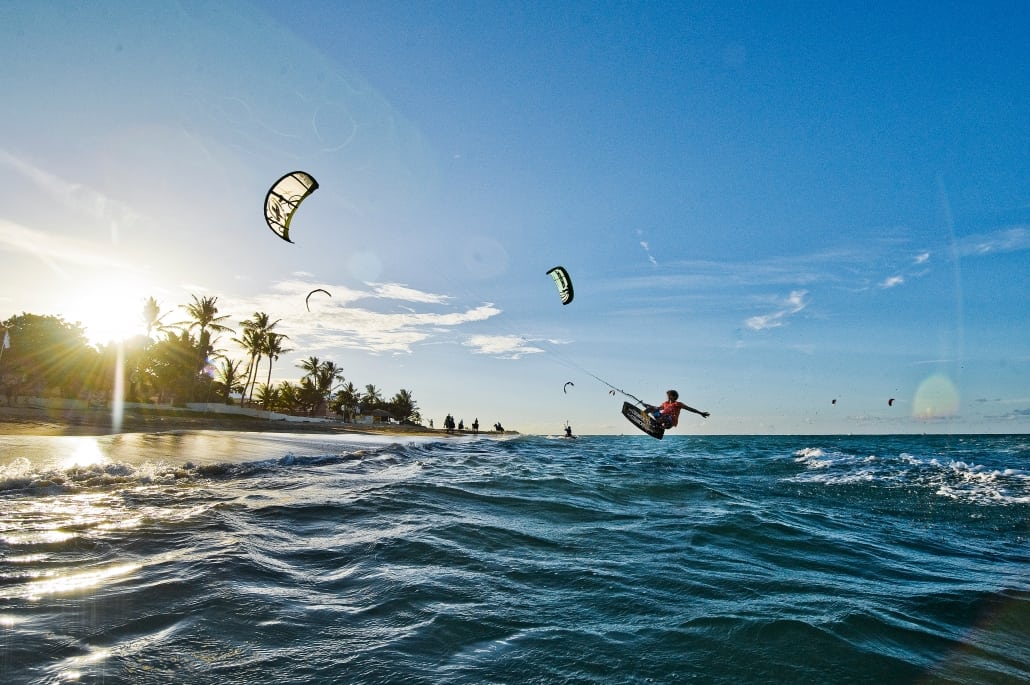
Cabarete is a world-famous watersports hub, so it’s no surprise it has some pretty amazing beaches. If you’re an active person looking to get the most adventure out of your vacation, this might just be the place for you. Cabarete is a small town with a big personality. It’s located on the North coast of the Dominican Republic, near Puerto Plata. Here’s a run-through of the best spots to kite, surf, windsurf, SUP, and swim! We’ll start at Cabarete Beach, the longest beach by the center of town, and work our way downwind. Cabarete Beach This is the most bustling beach in Cabarete, sporting many restaurants and shops, as well as the best wind on the island. In Cabarete, we are blessed with side-onshore wind, so it’s safer to be out on the water and ideal for beginners. You’ll find plenty of kite schools here, with instructors eager to show you the ropes and get you feeling confident. Windsurfers tend to hang out upwind on Cab Beach, because of a wind pocket. Kiters ride along the middle of beach, but be aware as it does get choppier as you move away from the point (near Janet’s supermarket). Crack out your SUP before the wind picks up, which is usually shortly after 11am. If you’re not into watersports, there’s lots of space to relax on Cabarete Beach. You can top up your enviable Caribbean tan, dive into a book, or strike up a conversation with a fellow sun-worshipper. And, of course, be sure to spend at least an afternoon sipping coconut water and mojitos until sunset. Bozo Beach Bozo is so named because it’s where you end up if you’re a beginner (or bozo) kiting on Cabarete Beach. That said, it’s a great place to be out on the water. So good, in fact, that this is where the pro kiters gather to show off their best tricks at competitions. There’s plenty of ocean space when you get out, though you sometimes find a bit of shore break and some chop. Bozo’s nearby reef is popular with kiters on directional boards. On a low-wind day, you’ll see confident bodyboarders and bodysurfers having fun at Bozo. Punta Goleta Punta Goleta is a calm place to soak up the sunshine away from the crowds. It’s a popular place for skimboarders to play around, and you can enjoy their antics from the beach. Kiters tend to steer clear of this area because of choppy waters and proximity to Kite Beach point. You can easily get yourself into a bad situation here, if you’re struggling to relaunch your kite, and drift toward the rocks near the point or the shallow reef. Not for beginners. Kite Beach Right on our doorstep, mere footsteps from La Mesa Taina restaurant in eXtreme, is the world-class Kite Beach. As the name suggests, this beach is a kiters dream. Perfect wind conditions on over 300 days a year, gorgeous sand, warm bright-blue water – if you’re lucky, you might even see turtles swimming around you when you’re out on the water! eXtreme guests enjoy prime access to Kite Beach, so you can be the first on the water when the wind picks up! We also have a grassy area where you can hose down and pack up your kit, away from the sand. You can store your kit just a few steps off the beach, and head straight to our farm-to-table restaurant to refuel. It doesn’t get more convenient than that. There are a good few kite schools around on Kite Beach, with skilled, experienced instructors to help you on your way. Safety tip: If you’re going around the point, be sure to give it a wide berth, since there are a good number of rocks. You’ll find the flattest water just downwind of the point. It’s common to see locals spear-fishing at the point, too. Kite Beach in the early morning is a magical place to be. Take a dip or have a paddle out on the glassy water. Experienced paddlers can find some paddle surf waves out on the reef. At eXtreme, The Yoga Loft is a serene space that looks out over the water. Join us there for morning practice to ground yourself before an active day. Mats and blocks are provided, so don’t worry about bringing your own equipment! Playa Encuentro Encuentro is THE place to rise and surf in Cabarete. Just a 5-minute moto ride from eXtreme, it’s a must-see if you’re a looking to catch some waves in the area. The variety of breaks makes it an ideal spot for surfers of all ability levels. First-timers can keep their cool in the Beginners’ Area (between Pauhana and Bobo’s), where mellow waves and helping hands abound. Seasoned experts can test their skills in the Destroyers or Coco Pipe breaks. You can rent boards there or bring your own. The guys from Pauhana Surf School are your best choice, excellent equipment and great teachers! Get down there early for a sunrise surf, before the wind and crowds start to build at around 9am. Big waves mean SUPs are not allowed here, and swimming is not advisable. Stick to the board. With 350 surfable days a year, Encuentro is a safe bet for your surfing holiday. Come and join the party! The beach in Cabarete is a year-round outdoor playground for adventure-seekers and ocean lovers, zen beach babes and party animals. As they say, the sun always shines in the Caribbean. Whether you’ve been on the water a day or a decade, you’ll soon feel at home on Cabarete’s friendly beaches.
Cabarete Day Trips: Canyoning and Waterfalls

Call me crazy, but sometimes it’s fun to take a day off the beach to explore the world outside Cabarete. If you’re itching for adventure, you could try a canyoning trip to check out some beautiful local caves and waterfalls. Don’t get me wrong, I love the ocean. Water sports are what brings many visitors to Cabarete, and that’s totally awesome. But if you stick to beach activities, you might miss out on the amazing playground of rivers, waterfalls and canyons. The Dominican Republic has so much to offer, it just takes a little boldness to explore. Adventure travel companies like Kayak River Adventures or Iguana Mama offer all-inclusive tours to the locations. These usually include transport and a meal, sometimes even a couple of drinks to settle your nerves after a thrill. They have all the equipment and invaluable local knowledge to keep you super safe while you jump into natural pools of water. If you’re looking for a simpler deal, there are some spots like Laguna El Dudú where you don’t need a guide. Our hotel staff can help you organise transport to and from the location. Let’s take a look at some of Cabarete’s day trip canyon options. Magic Mushroom Cabarete residents rave about Magic Mushroom. Not the hallucinogenic drug, the stunning mushroom-shaped rocky waterfall. The adventure on offer at Magic Mushroom is to hike through the Dominican jungle to abseil/rappel 160ft (55m) down an amazing waterfall into a clear pool of water. There are a few insane cliff jumps that you can enjoy, too, if you’re up for it. The second rappel point can be jumped, which is a good 45ft (15m) high! The base camp is a 45-minute drive from Cabarete. Tours usually take a good few hours, so clear a whole chunk of the day for this epic adventure. Big Bastard Nearby to Magic Mushroom, along the river, you’ll find a beastly 60ft (20m) canyon jump known as Big Bastard. No need to explain why. This is not for people new to jumping off things into water. If that’s too daunting, there is a 49ft (15m) jump, as well as other platforms at lower heights where you can leap into the clear deep-green water. Ciguapa Falls A cascading tour of Ciguapa Falls will take you around its 6 awesome waterfalls, with a range of jumps up to 30ft (10m) high. If you don’t fancy the hike back to base camp after all that jumping, you can take a donkey. Pretty chill. 27 Waterfalls of Damajagua ‘27 Waterfalls’, or ‘27 Charcos’ in Spanish, is on the bucket list of many Dominicans and visitors to the North Coast of the DR. The tour starts with a 70-minute hike into the jungle, so you’re going to have to be fairly fit to get on board with this. There are, you guessed it, 27 waterfalls of varying heights that you can jump off. The pools of water are stunning and cool, perfect for splashing around in. The rush of the flowing river water over time has carved grooves in the rock. For us, that means natural water slides! Thankfully, there are always lots of options for jump heights, and of course there shouldn’t be any pressure to take a jump you’re not comfortable with. It’s your day out on in a natural playground and you are free to enjoy it exactly as you like! Laguna El Dudú As I mentioned above, Laguna El Dudú is a spot that’s accessible without an adventure tour guide company. The clear water, caves and lush forest make it a beautiful place to spend the afternoon, and it’s reasonably close to Cabarete, less than an hour and a half’s drive. It makes for a great stopover to break up a longer trip down the coast. If you’re heading to Las Terrenas, Samana, Las Galeras, or basically anywhere to the East, you can stop for a refreshing dip in the Dudú pools before heading on. The laguna is a gorgeously cool bright-turquoise pool. There’s a zip line you can ride that runs over the canyon, with a compulsory drop into the water. You can pay 25 pesos to have a go, step up if you dare. Not for the fainthearted, the 8- to 9-metre-drop promises quite the adrenaline rush. As someone very new to jumping into water from a height, the jump was a bit of a shock, but I’m glad I did it! When you let go of the handle, just be sure to fall like a pencil and look straight ahead. Oh, and lifejackets are provided. There is a smaller pool, half in the shade of a cave, which is a lush place to chill and swim in the crystal-clear water. Very family appropriate. There’s even a little baby jump off the side of a rock that you can enjoy if you’re not into heights. There are some caves to explore, too, so you can look at some impressive rock formations. With an onsite bar and restaurant, you can easily spend a whole day relaxing by the pools at Laguna El Dudú. Clamber on! Adventure really is around every corner in Cabarete, and it’s worth taking some time to do something a little different on your active vacation. If clambering in caves and abseiling off waterfalls sounds like your cup of tea, the Dominican Republic has got you covered. Chat to eXtreme Hotel’s friendly reception staff for more information about conditions and touring groups.
Kiteboarding Lingo for Beginners

If you’re in Cabarete, a world-famous kiteboarding capital, you should probably get up to speed with some kiting lingo. Whether you’re out on the water or staying dry on the beach. How else will you be able to understand what all the kiters are talking about? New to kiteboarding? Let me help you out with some kiting keywords to try out on the beach. That way you won’t be body-dragging socially, as well. Kiteboarding is a relatively new sport, with the first competitive kiting event held in 1998 in Maui, Hawaii. But in the space of two decades, the sport has spawned a lot of lingo. Let’s launch right into it. Kiteboarding Basics Air time, hang time: the amount of time spent in the air during a jump body-dragging: being pulled along in the water without your board. You learn to body-drag before kiteboarding to practise flying the kite, and you’ll need this skill to recover a lost board in the water boost: send the kite up through the power zone to lift the rider into the air de-power: adjusting the angle of the kite to reduce its power and make it easier to handle a downwinder: a planned long journey downwind, without attempting to drive upwind. A little forethought is required if you need to transport yourself and your kit back to where you started edge: tilting the board’s edge into the water to steer or control power in the kite heel side: the side of the kiteboard where your heels are. ‘Riding heelside’, with heels down, is the standard kiteboarding position launch: the process of getting your kite up in the air, typically with the help of another person guinea pig, wind dummy: the kiter who goes out first to test the conditions relaunch: getting the kite back in the air after it has crashed down onto the water or land send the kite: move the kite up through the power zone overpowered: having too much power from the kite, making it unmanageable. You may need to switch to a smaller kite or wait until the wind is less strong. toe side: the side of the kiteboard where your toes are, opposite to heel side underpowered: not having enough power for your kite, you may need to switch to a larger kite unhooked: riding when the chicken loop is not attached to the harness The Wind upwind: the direction where the wind is blowing from; into the wind downwind: the direction the wind is blowing to. Facing downwind, the wind is at your back side shore: wind blowing parallel to the shore side onshore: wind blowing between side shore and 45 degrees towards the shore side offshore: wind blowing between side shore and 45 degrees away from the shore power zone: part of the wind window that will give you the biggest pull, an arc between 0 and 60 degress from the centre of the downwind direction wind window: the 120-180 degree arc of the sky downwind of a rider where the kite can be flown. Outside of the wind window, kites will stall and fall out of the sky. zenith: part of the wind window directly above a rider’s head. Riders position the kite here to stop moving or before a movement, as it is a neutral spot nuking: extreme wind conditions of around 30-40 knots Kiteboarding Gear control bar: the bar you hold to fly the kite chicken loop: hard rubber loop that attaches the control bar to the harness, so you can use your body weight to fly the kite and not just your arms chicken bone, chicken finger: hard rubber tongue, attached to the chicken loop, that is fed through the spreader bar hook. Allows you to ride ‘hooked’ rather than ‘unhooked’ directional: surfboard-style kiteboard with one tip that you can only ride in one direction, great for surfing waves while kiting spreader bar: stainless steel bar that attaches to the harness and holds the chicken loop twin tip: bi-directional kiteboard with two straps or boots for your feet. You can ride right foot or left foot forward, as the board is symmetrical Freestyle Kiteboarding Tricks backroll: a backward 360 rotation in the air big air: a very high jump front roll: a forward 360 rotation in the air handlepass: passing the control bar around behind your back while in the air and unhooked kiteloop: making the kite do a loop while you are at the apex of your jump. This is advanced stuff and very highly powered mobe: a backroll with a 360 frontside handlepass. More generally, any trick involving an invert and 360 spin raley: unhooked jump where legs fly up behind you Superman-style. One of the first unhooked moves riders learn stomp: to successfully perform a trick When it all goes wrong Hindenburg: when a kite stalls and falls out of the sky, a reference to the Hindenburg airship disaster of 1937. kitemare: a kiting accident or mishap kook: an overconfident, erratic rider who lacks control and may put others in danger lofted: being lifted vertically in the air by a strong gust of wind. Can be very dangerous if kiting near the shore or rocks luff: when the air flow stalls around the kite. A luffing kite will ripple, flap and maybe fall out of the sky mowing the lawn: uninspiring kiting style, tacking back and forth repeatedly without variation schlogging: riding severely underpowered, usually bouncing and dragging in the water tea-bagging: being lifted and dunked into the water, perhaps due to gusts of wind or twisted lines walk of shame: the walk along the beach upwind to where you launched your kite, due to an inability to drive upwind yard sale: a spectacular fail at a trick that sends your gear flying around you like items at a yard sale Now, off to Kite Beach You’re ready with all the lingo you’ll need to chat to kiters on Kite Beach. Cabarete is a haven for watersports lovers from all over the world. With consistently perfect wind conditions on 300+ days
Dominican Baseball Legends: 2nd Innings

Welcome back to part 2 of our look at Dominican baseball legends. (You can catch up on part 1 here.) We are diving into the Dominican Republic’s national sport: baseball. In case you hadn’t heard, it’s pretty big here. Without further ado, let’s meet our next Major League star! David Ortiz aka ‘Big Papi’ Ortiz was one of the most powerful sluggers of all time. From 2003, he was the designated hitter for the Red Sox, and teamed up with Martinez to help the Red Sox to their 2004 big win at the World Series. During his 14 seasons with the Red Sox, Ortiz was a ten-time All-Star, a three-time World Series champion, and seven-time Silver Slugger winner. Ortiz holds the Red Sox single-season record for home runs with 54, which he set during the 2006 season. He has the highest career batting average in World Series play at .455. Among designated hitters, he is the all-time leader in MLB history for home runs (485), runs batted in (1,569), and hits (2,192). Regarded as one of the best clutch hitters of all time, Ortiz had 11 walk-off home runs during the regular season and 2 during the postseason. In 2007, Ortiz founded the David Ortiz Children’s Fund to support children in the DR and New England who can’t afford life-saving heart surgery. He was so moved by the resilience of the children in a Santo Domingo hospital ward that he promised to help them. His wine label Vintage Papi, founded in 2008, has raised $150,000 for the Children’s Fund. Sammy Sosa ”Slammin’ Sammy’ was a 7-time All-Star right fielder who joined the Chicago Cubs in 1992. He was National League MVP in 1998, who won six Silver Slugger Awards. Sosa hit his 400th home run in his 1,354th game and his 5,273rd at-bat, a milestone he reached more quickly than any player in National League history. Sosa is best known for being involved in the ‘home-run record chase’ of 1998. Sosa and Mark McGwire made it their mission to beat Roger Maris’ single-season home-run record of 61, which stood from 1961. Though Sammy broke the record with 66 homers, McGwire ended the season on a triumphant 70. However, Sosa is still the only player to have hit 60 or more home runs in a single season three times in his career. He was also the fifth of just nine players in MLB history to hit 600 career home runs. Sosa is second all-time in home runs among foreign-born MLB players and is one of only three National League players since 1900 to reach 160 RBIs in a season (2001). Other big names Albert Pujols, Vladimir Guerrero and Miguel Tejada all won National League MVP Awards. Bartolo Colon won the Cy Young Award in 2005. Robinson Canó is a 8-time All-Star, 5-time Silvaer Slugger, 2-time Golden Glove winner who plays for the Seattle Mariners. He won the World Series with the Yankees in 2009. José Reyes is a 4-time All-Star infielder for the New York Mets. He is the Mets’ all-time leader in triples and stolen bases, and has the most stolen bases among all active players right now (over 500). Baseball in the DR – don’t miss it! These baseball heroes hold a special place in Dominican culture. They are representatives of Dominican achievement in the world. Many of them come from small towns and humble upbringings, having improvised equipment out of tree branches, cloth and golf balls as children. They act as symbols of hope and opportunity for thousands of fans. When you visit the DR, pay attention to the baseball scene. It is a lively and passionate game, beloved by Dominicans. If you get the chance to go along to a ‘juego de pelota’ you’ll get a real glimpse into the local culture. Even if sports isn’t your thing, you can count on the Dominicans to throw a wild after-party!
Dominican Baseball Legends

In case you didn’t know, the Dominican Republic goes mad for baseball. Called béisbol or just pelota (ball), it’s the DR’s national sport. Through the winter months (October-January), fans avidly follow their national baseball league, called LIDOM (LIga de béisbol de la Républica DOMinicana). If you want a real cultural adventure on your vacation, check out a LIDOM baseball game. See if you can keep up! Dominican baseball fans also keenly track the progress of Dominican players in the Major League. Many young players aspire to one day play for their favourite national team, and maybe even be signed by a MLB team. Their local baseball heroes prove it can be done, and offer the glinting hope of future stardom. Did you know? After the United States, the Dominican Republic is the country that contributes the largest number of players to Major League Baseball. In the 2017-18 season, MLB signed a record 612 Dominican players. Bonuses are estimated to total around $70 million (USD). Legendary. Many Dominican players have pitched and batted their way to become national heroes and have gone down as legends in the sport. Let’s take a look at some of the world-class sporting talent that has come out of the DR: Juan Marichal Marichal is Dominican baseball royalty. A right-handed pitcher for the San Francisco Giants in the 1960s, he was inducted into the National Baseball Hall of Fame in 1983. He was a 10-time All-Star, known for his precision with the ball and his intimidation tactics. He is said to have deliberately aimed his pitches at the batters’ helmets to give them a scare! Marichal’s delivery was spectacular: his left leg kicked almost vertical in a fearsome windup. Remarkably, his kick retained its height throughout his career, and photos show it only lowered slightly by his retirement. The elaborate windup meant you couldn’t tell what he was going to pitch until it was coming at you! His number 27 was retired by the Giants in 1975. Juan Marichal is treasured by Dominican baseball fans. The Estadio Quisqueya in Santo Domingo, home of the Tigres del Licey and the Leones del Escogido, was renamed the Estadio Quisqueya Juan Marichal in 2015, in honour of his contribution to Dominican baseball. Pedro Martinez Martinez was a starting pitcher for the Boston Red Sox and New York Mets. He played a huge part in helping the Boston Red Sox end their 86-year drought and win the World Series in 2004. He is recognised as one of the greatest pitchers in MLB history, and was inducted into the Hall of Fame in 2015. Statistically, Martinez is incredibly impressive. An 8-time All-Star, Martinez’ best years were 1997-2003. He won the Cy Young Award three times, posting a cumulative record of 118–36 (.766) with a 2.20 ERA. In 1999, he was runner-up for the American League (AL) Most Valuable Player Award after winning the pitching Triple Crown with a 23–4 record, 2.07 ERA and 313 strikeouts. He reached the dizzying heights of winning the Cy Young Award in both the American and National Leagues – a rare feat. He also holds the record for the lowest single-season WHIP in major league history (0.737 in 2000) and the lowest single-season Fielding Independent Pitching (FIP) in the live ball era (1.39 in 1999). From 2002 to 2006, Martinez held the major league record for the highest career winning percentage by a pitcher. He retired in December 2011 with the fourth-highest percentage in history, and the highest by a right-hander since 1893. The Smithsonian’s National Portrait Gallery bought an oil painting of Martinez for their collection in 2011. Stay Tuned… Next time on Dominican Baseball Legends, we’ll meet David Ortiz, the pro baseball star with a heart for making a difference, and Sammy Sosa, the home-run record chaser! In the meantime, don’t miss out on the chance to attend a baseball match while you’re in the Dominican Republic. It could be the cultural experience you never knew you needed!